




Insect superorganisms are among the most advanced biological systems in nature because they function not as individual insects but as unified living societies where thousands or even millions of members behave like a single coordinated entity, and unlike solitary animals that depend on individual intelligence, insects such as ants, bees, and termites achieve survival through collective decision-making, role specialization, chemical communication, and highly efficient social organization, making their colonies some of the most successful and stable life systems on Earth.
🌿 What Is a Superorganism?
A superorganism is a biological concept where an entire colony behaves like one unified organism, meaning that individual insects act like cells within a larger body, each performing specific functions that contribute to the survival of the whole system, and in this structure the queen acts as a reproductive unit, workers function as maintenance and operational units, and soldiers provide defense, creating a complete living system that operates with extreme efficiency and coordination.
🐜 Ant Colonies: Master Engineers of Cooperation
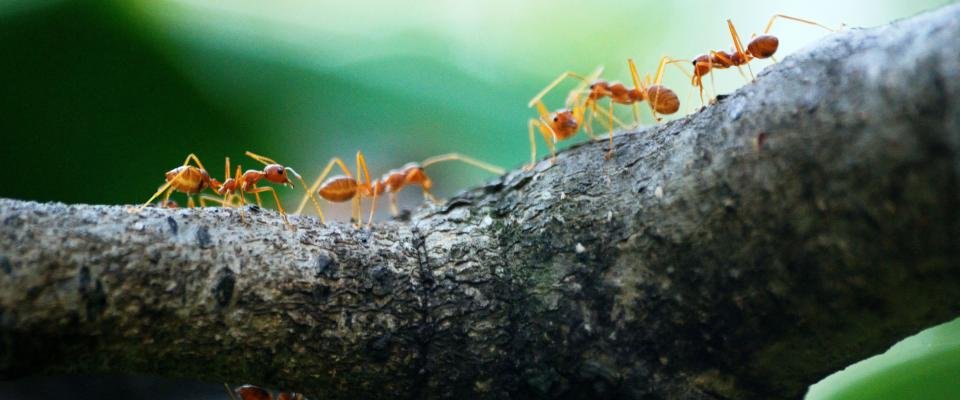
Ant colonies are highly organized societies that can contain thousands to millions of individuals working together through chemical signals called pheromones, which allow ants to communicate information about food sources, danger, and navigation routes, and this chemical communication system enables ants to build complex underground tunnels, form bridges using their own bodies, and organize large-scale food collection systems without centralized control.
Ants also demonstrate swarm intelligence, meaning that simple individual behaviors combine to create complex collective outcomes.
🐝 Bee Colonies: Precision-Based Social Intelligence
Bee colonies operate with extreme precision and coordination, where each bee has a specific role such as foraging, nursing larvae, cleaning the hive, or defending the colony, and communication is achieved through the famous “waggle dance,” which allows bees to share detailed information about the direction and distance of food sources using movement patterns.
This system allows the entire colony to function as a highly efficient biological network capable of large-scale food production and environmental adaptation.
🏰 Termite Mounds: Natural Architectural Engineering
Termites are famous for constructing massive and highly complex mound structures that function as natural climate-controlled buildings, maintaining stable temperature and humidity inside despite extreme external conditions, and these structures are built using soil, saliva, and organic material, forming ventilation systems, underground tunnels, and chambers for food storage, reproduction, and waste management.
Termite architecture is so advanced that it has inspired human building designs in sustainable architecture and passive cooling systems.
🧠 Collective Intelligence Without a Brain
One of the most fascinating aspects of insect superorganisms is that they achieve complex decision-making without a central brain, and instead intelligence emerges from simple interactions between individuals following basic behavioral rules, where local communication leads to global coordination, allowing colonies to solve problems such as finding food, defending territory, and building structures through decentralized intelligence.
🌍 Ecological Importance of Insect Superorganisms
Insect colonies play critical roles in ecosystems by pollinating plants, recycling organic matter, controlling pest populations, and modifying soil structures, and without these insects many ecosystems would collapse because they maintain the balance between plant growth, decomposition, and food chain stability, making them essential drivers of biodiversity and environmental health.
⚠️ Survival Strategies and Environmental Adaptation
Insect superorganisms survive through adaptability, rapid reproduction, division of labor, and resilience against environmental changes, and because colonies can sacrifice individual members for the survival of the group, they are extremely resistant to disasters, predators, and environmental fluctuations, making them some of the most successful survival systems in biological history.
🧬 Scientific Inspiration from Superorganisms
Scientists study insect colonies to develop algorithms in artificial intelligence, robotics, logistics, and network optimization, because swarm intelligence principles can be applied to solve complex human problems such as traffic flow, data processing, and distributed computing, showing that biological systems often provide models for advanced technological design.
🌿 Conclusion
Insect superorganisms represent one of nature’s most efficient forms of life organization because they combine communication, cooperation, specialization, and adaptability into unified systems that function like living machines, and their ability to achieve complex outcomes without centralized control makes them one of the most important biological models for understanding intelligence, survival, and collective behavior in nature.
❓ FAQ
1. What is a superorganism?
A colony where individuals act like parts of a single organism.
2. How do ants communicate?
Through chemical signals called pheromones.
3. What is the waggle dance?
A bee communication method for sharing food location.
4. Why are termites important?
They recycle wood and build climate-controlled structures.
5. Do insect colonies have leaders?
Not in a traditional sense; they operate through decentralized systems.