



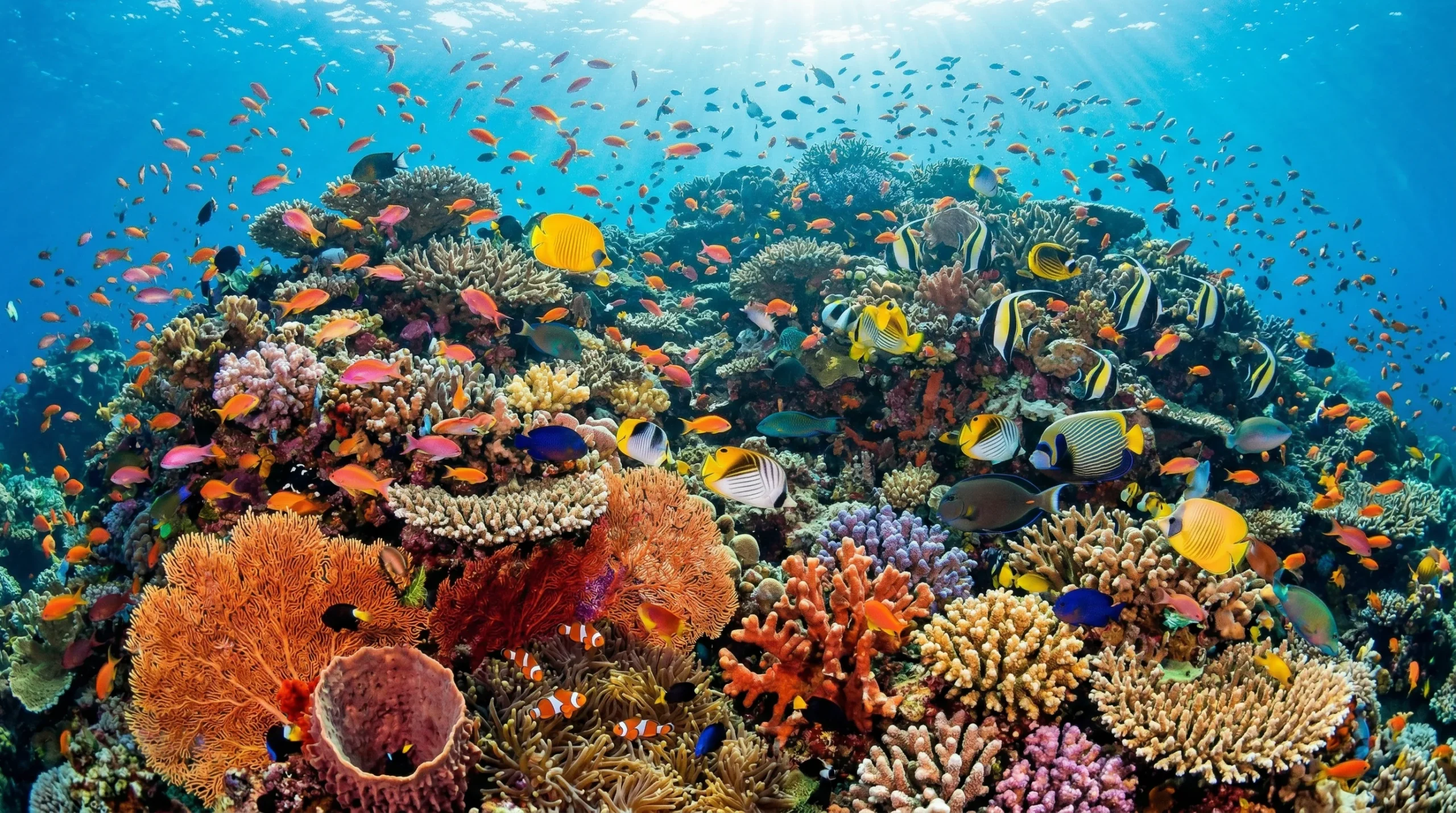
Coral reefs are among the most biologically rich and ecologically important ecosystems on Earth. Often called the “rainforests of the sea,” they are not made of plants or rocks, but of living colonies of tiny animals called coral polyps. These organisms build massive calcium carbonate structures over thousands of years, forming complex underwater cities that support thousands of marine species.
Despite covering less than 1% of the ocean floor, coral reefs support around 25% of all marine life. They function as breeding grounds, feeding zones, shelter systems, and biodiversity hubs for fish, crustaceans, mollusks, and countless microorganisms. Their ecological importance extends far beyond marine life, influencing global climate regulation, coastal protection, and human economies.
This deep guide explores coral reef formation, biological structure, symbiotic relationships, ecosystem function, climate vulnerability, reproduction systems, biodiversity dynamics, and survival challenges in extraordinary scientific detail.
Coral Reef Formation and Geological Growth
Coral reefs form through the long-term biological activity of coral polyps.
Coral Polyps as Reef Builders
Each coral is made up of thousands of tiny animals called polyps. These organisms:
- Secrete calcium carbonate skeletons
- Build protective exoskeleton structures
- Live in colonies that expand over time
As generations of polyps grow and die, their skeletons accumulate, forming reef structures.
Reef Growth Over Time
Coral reefs grow extremely slowly:
- A few millimeters to centimeters per year
Over thousands of years, this slow accumulation creates:
- Massive reef systems
- Barrier reefs
- Atolls and reef islands
Types of Coral Reefs
There are three main reef types:
- Fringing reefs (near shorelines)
- Barrier reefs (separated from land by lagoons)
- Atolls (ring-shaped reefs around submerged volcanoes)
Each type forms under different geological conditions.
Coral Anatomy and Biological Structure
Corals are animals, not plants, despite their appearance.
Polyp Structure
A coral polyp includes:
- A soft tubular body
- A mouth surrounded by tentacles
- Stinging cells (nematocysts)
These features allow corals to capture tiny plankton.
Symbiotic Algae
Inside coral tissues live microscopic algae called zooxanthellae.
These algae:
- Perform photosynthesis
- Provide energy to corals
- Give corals their vibrant colors
In return, corals provide:
- Protection
- Access to sunlight
- Carbon dioxide for photosynthesis
Coral Symbiosis and Energy Exchange
Coral reefs depend on one of nature’s most important symbiotic relationships.
Photosynthetic Energy System
Zooxanthellae convert sunlight into energy, producing:
- Sugars
- Oxygen
- Nutrients
Up to 90% of coral energy comes from this relationship.
Mutual Dependence
Corals and algae depend on each other for survival:
- Without algae, corals lose color and energy (bleaching)
- Without corals, algae lose habitat and protection
This relationship is highly sensitive to environmental change.
Coral Reef Ecosystems and Biodiversity
Coral reefs are among the most diverse ecosystems on the planet.
Marine Species Diversity
Reefs support:
- Fish species
- Sea turtles
- Sharks
- Crustaceans
- Mollusks
- Sponges
Many species depend entirely on reefs for survival.
Food Web Complexity
Reefs contain complex food chains:
- Primary producers (algae)
- Herbivores (small fish)
- Carnivores (larger fish)
- Apex predators (sharks)
Energy flows through tightly interconnected systems.
Habitat Engineering
Corals physically shape ecosystems by:
- Creating shelter spaces
- Forming reef structures
- Stabilizing marine environments
Coral Communication and Biological Responses
Although corals lack nervous systems, they still respond to environmental signals.
Chemical Signaling
Corals can:
- Release chemical signals
- Detect stress in nearby corals
- Respond to environmental changes
Behavioral Responses
Corals respond to:
- Light intensity
- Water temperature
- Pollution levels
These responses affect growth and survival.
Coral Reproduction and Life Cycle
Corals reproduce through both sexual and asexual methods.
Spawning Events
Many corals reproduce by mass spawning:
- Millions of eggs and sperm released into water
- Fertilization occurs externally
These synchronized events often occur annually.
Asexual Reproduction
Corals also grow by:
- Budding new polyps
- Expanding colony structures
This allows reef expansion over time.
Larval Stage
After fertilization:
- Coral larvae float in ocean currents
- Eventually attach to surfaces
- Begin new colony formation
Coral Reef Climate Regulation Role
Coral reefs play a major role in Earth’s climate systems.
Carbon Cycling
Corals help regulate:
- Carbon dioxide levels
- Ocean chemistry
They store carbon in calcium carbonate structures.
Coastal Protection
Reefs act as natural barriers by:
- Reducing wave energy
- Protecting shorelines from storms
- Preventing coastal erosion
Ocean Stability
Healthy reefs contribute to:
- Water clarity
- Nutrient balance
- Marine ecosystem stability
Coral Bleaching and Environmental Stress
Coral reefs are highly sensitive to environmental changes.
Bleaching Process
When stressed by heat or pollution:
- Corals expel zooxanthellae
- Lose color and energy
- Become weak and vulnerable
Causes of Bleaching
Major causes include:
- Rising ocean temperatures
- Ocean acidification
- Pollution
- Overexposure to sunlight changes
Recovery Potential
If conditions improve:
- Corals can regain algae
- Partial recovery is possible
- Severe damage may be permanent
Ocean Acidification and Chemical Changes
Increasing CO₂ levels affect ocean chemistry.
pH Reduction
More carbon dioxide leads to:
- Lower ocean pH
- Increased acidity
Impact on Corals
Acidic water:
- Reduces calcium carbonate formation
- Weakens coral skeletons
- Slows reef growth
Coral Predators and Natural Threats
Corals face natural biological threats.
Crown-of-Thorns Starfish
These starfish:
- Feed on coral tissue
- Can destroy large reef sections
Parrotfish and Grazers
Some fish:
- Scrape coral surfaces
- Control algae growth
- Balance reef ecosystems
Disease Outbreaks
Corals can suffer from:
- Bacterial infections
- Tissue loss diseases
Human Impact on Coral Reefs
Human activity is the greatest threat to coral survival.
Pollution
Marine pollution includes:
- Plastics
- Chemicals
- Agricultural runoff
These damage coral health and water quality.
Overfishing
Removing key species disrupts:
- Food chains
- Reef balance
- Algae control systems
Coastal Development
Construction leads to:
- Habitat destruction
- Sediment increase
- Water quality decline
Coral Reef Conservation Science
Efforts are underway to protect coral ecosystems.
Marine Protected Areas
These zones restrict:
- Fishing
- Tourism damage
- Industrial activity
Coral Farming
Scientists grow coral fragments in controlled environments:
- Then transplant them into reefs
- Helps restore damaged ecosystems
Genetic Research
Researchers study:
- Heat-resistant coral strains
- Disease resistance
- Adaptation potential
Coral Reefs in Human Economy and Society
Coral reefs support human life indirectly.
Fisheries Support
Millions of people rely on reefs for:
- Food supply
- Fishing industries
Tourism Economy
Reefs generate income through:
- Diving tourism
- Marine recreation
Pharmaceutical Research
Corals inspire:
- Medical compounds
- Antibiotic research
- Biomedical discoveries
Future of Coral Reef Ecosystems
The future of coral reefs depends on global environmental stability.
Climate Threats
Major risks include:
- Rising ocean temperatures
- Sea level changes
- Acidification
Adaptation Potential
Some corals show:
- Heat resistance
- Faster adaptation rates
Scientific Hope
Advanced conservation strategies aim to:
- Restore reef systems
- Improve resilience
- Protect biodiversity
Conclusion
Coral reefs are living underwater cities built by tiny organisms that create some of the most complex and diverse ecosystems on Earth. Through symbiosis, slow growth, and biological engineering, corals support vast marine biodiversity while protecting coastlines and contributing to global environmental balance.
Despite their importance, coral reefs face severe threats from climate change, pollution, and human activity. Their survival is closely tied to the health of the entire ocean system and ultimately the planet’s ecological stability.
Coral reefs remain one of nature’s greatest masterpieces—fragile yet powerful ecosystems that demonstrate the deep interconnectedness of life beneath the ocean surface.