




Ocean currents are continuous, directed movements of seawater that circulate across the planet’s oceans, forming a vast global conveyor system. These currents act as Earth’s heat distribution network, transferring energy from warm equatorial regions toward colder polar areas and maintaining global climate balance.
Driven by wind, temperature differences, salinity gradients, and Earth’s rotation, ocean currents influence weather patterns, marine ecosystems, nutrient distribution, and even long-term climate stability. Without these currents, many regions of Earth would become either extremely hot or extremely cold, and global climate systems would become unstable.
Ocean currents operate on both surface and deep levels, creating a connected three-dimensional circulation system that spans the entire planet.
Forces Driving Ocean Currents
Ocean movement is controlled by multiple interacting physical forces.
Wind-Driven Circulation
Surface currents are primarily powered by:
- Global wind patterns
- Atmospheric pressure systems
- Friction between air and ocean surface
Trade winds and westerlies push water across vast ocean basins.
Coriolis Effect
Earth’s rotation causes moving water to deflect:
- Right in the Northern Hemisphere
- Left in the Southern Hemisphere
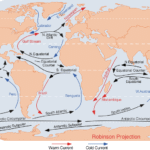
This effect shapes circular current systems called gyres.
Thermohaline Circulation
Deep ocean currents are driven by:
- Temperature differences (thermal)
- Salinity differences (haline)
Cold, salty water sinks while warm water rises, creating global circulation loops.
Major Ocean Current Systems
Ocean currents are organized into large-scale systems.
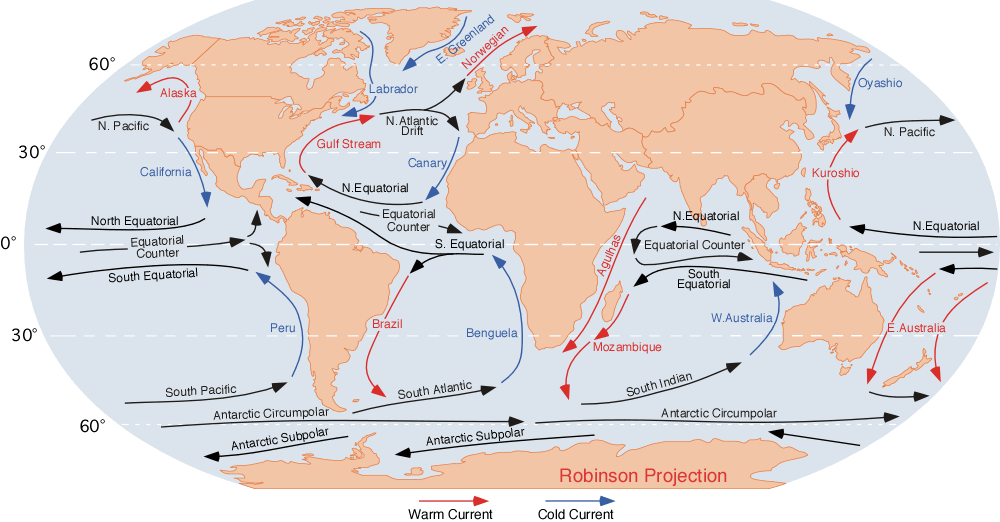
Surface Gyres
Gyres are rotating current systems found in major oceans:
- North Atlantic Gyre
- South Atlantic Gyre
- Pacific Gyres
- Indian Ocean Gyre
These systems move water in circular patterns.
Gulf Stream
The Gulf Stream is a powerful warm current:
- Moves warm water from the tropics toward Europe
- Moderates climate in Western Europe
- Influences weather systems across the Atlantic
Antarctic Circumpolar Current
This is the strongest ocean current on Earth:
- Circles Antarctica continuously
- Connects multiple ocean basins
- Regulates global heat exchange
Deep Ocean Conveyor Belt
The global ocean circulation system connects surface and deep waters.
Thermohaline Circulation Loop
This system works as follows:
- Warm surface water moves toward poles
- Water cools and becomes denser
- It sinks into deep ocean layers
- Deep water slowly returns toward equator
This cycle can take hundreds to thousands of years.
Global Climate Connection
This conveyor belt:
- Distributes heat globally
- Regulates long-term climate stability
- Controls deep ocean oxygen levels
Ocean Currents and Climate Regulation
Ocean currents are essential for Earth’s climate system.
Heat Redistribution
Currents move heat:
- From equator to poles
- From ocean to atmosphere
This prevents extreme temperature imbalance.
Weather Influence
Ocean currents affect:
- Storm formation
- Rainfall patterns
- Seasonal climate behavior
Climate Stability
Without ocean circulation:
- Equator would overheat
- Poles would freeze completely
- Weather systems would collapse
Marine Ecosystems and Nutrient Transport
Ocean currents support marine life on a global scale.
Nutrient Upwelling
Currents bring nutrients from deep water:
- Supports plankton growth
- Enhances marine productivity
Food Chain Foundation
Phytoplankton depend on:
- Sunlight
- Nutrients delivered by currents
This supports entire marine food webs.
Migration Pathways
Many marine species use currents for:
- Migration routes
- Spawning transport
- Habitat connectivity
Ocean Currents and Oxygen Production
Ocean circulation supports atmospheric oxygen balance.
Phytoplankton Role
Phytoplankton produce:
- A significant portion of Earth’s oxygen
- Through photosynthesis in surface waters
Oxygen Distribution
Currents help:
- Distribute oxygen-rich water
- Maintain marine respiration systems
Climate Events and Ocean Current Disruption
Ocean currents are sensitive to environmental changes.
El Niño and La Niña
These are climate anomalies caused by:
- Changes in Pacific Ocean currents
- Disruption of normal circulation patterns
Effects include:
- Floods
- Droughts
- Temperature anomalies
Global Impact
Even small changes in currents can affect:
- Agriculture
- Weather systems
- Ecosystem stability
Ocean Currents and Carbon Cycle
Ocean currents play a major role in carbon regulation.
Carbon Absorption
Oceans absorb:
- Large amounts of atmospheric CO₂
Carbon Storage
Deep ocean currents transport:
- Carbon-rich water into deep layers
- Long-term carbon sequestration
Human Impact on Ocean Circulation
Human activity is beginning to affect ocean systems.
Climate Change Effects
Rising temperatures:
- Alter current strength
- Disrupt circulation patterns
Pollution Impact
Plastics and chemicals:
- Travel through current systems
- Accumulate in ocean gyres
Ice Melt Influence
Melting polar ice:
- Changes salinity balance
- Weakens deep ocean circulation
Scientific Monitoring of Ocean Currents
Scientists study currents using advanced tools.
Satellites
Measure:
- Sea surface height
- Temperature patterns
Drifting Floats
Track:
- Water movement at different depths
- Long-term circulation patterns
Ocean Models
Computer simulations predict:
- Climate changes
- Current shifts
- Ecosystem impacts
Conclusion
Ocean currents form Earth’s global circulation system, regulating climate, distributing heat, supporting marine ecosystems, and controlling nutrient and carbon cycles. These vast moving systems connect all oceans into a single dynamic network that maintains planetary balance.
By transferring energy and matter across continents and depths, ocean currents ensure the stability of Earth’s climate and the survival of marine life. Understanding these systems is essential for predicting climate change and protecting global environmental health.