







Black holes are among the most extreme and mysterious objects in the universe. They are not “holes” in the traditional sense, but regions of space where gravity becomes so intense that nothing—not even light—can escape once it crosses a boundary called the event horizon. Formed from the collapse of massive stars or through other cosmic processes, black holes represent a point where physics as we currently understand it begins to break down.
Modern astrophysics studies black holes not only as destructive cosmic objects, but also as essential components of galaxy formation, energy regulation, and space-time structure. They influence star movement, shape galactic cores, and may even play a role in the evolution of the universe itself.
This deep guide explores black hole formation, anatomy, physics, event horizons, time dilation, quantum behavior, detection methods, and their role in cosmic evolution in extraordinary detail.
Black Hole Formation and Stellar Collapse
Black holes are born when massive stars reach the end of their life cycle.
Stellar Evolution Before Collapse
A star remains stable for most of its life due to a balance between:
- Outward pressure from nuclear fusion
- Inward pull of gravity
When fuel runs out, this balance collapses.
Supernova Explosion
For large stars, the end stage is a violent supernova explosion:
- Outer layers are ejected into space
- The core collapses inward
If the remaining core is massive enough, it compresses into a black hole.
Mass Threshold
Typically:
- Stars above ~20–25 solar masses may form black holes (depending on composition and collapse dynamics)
Smaller stars become neutron stars instead.
Anatomy of a Black Hole
Despite being invisible, black holes have distinct structural regions.
Event Horizon
The event horizon is the boundary where escape velocity equals the speed of light.
Once crossed:
- Escape is impossible
- Information cannot return
- Time behaves abnormally from an outside perspective
It is not a physical surface but a mathematical boundary.
Singularity
At the center lies the singularity:
- A point of infinite density
- Zero volume (as predicted by classical physics)
- Where space-time curvature becomes extreme
Current physics cannot fully describe this region.
Accretion Disk
Many black holes are surrounded by:
- Hot gas
- Dust
- Plasma
This material forms an accretion disk that:
- Heats up due to friction
- Emits X-rays and radiation
- Spirals inward before crossing the event horizon
Space-Time Distortion and Gravity Physics
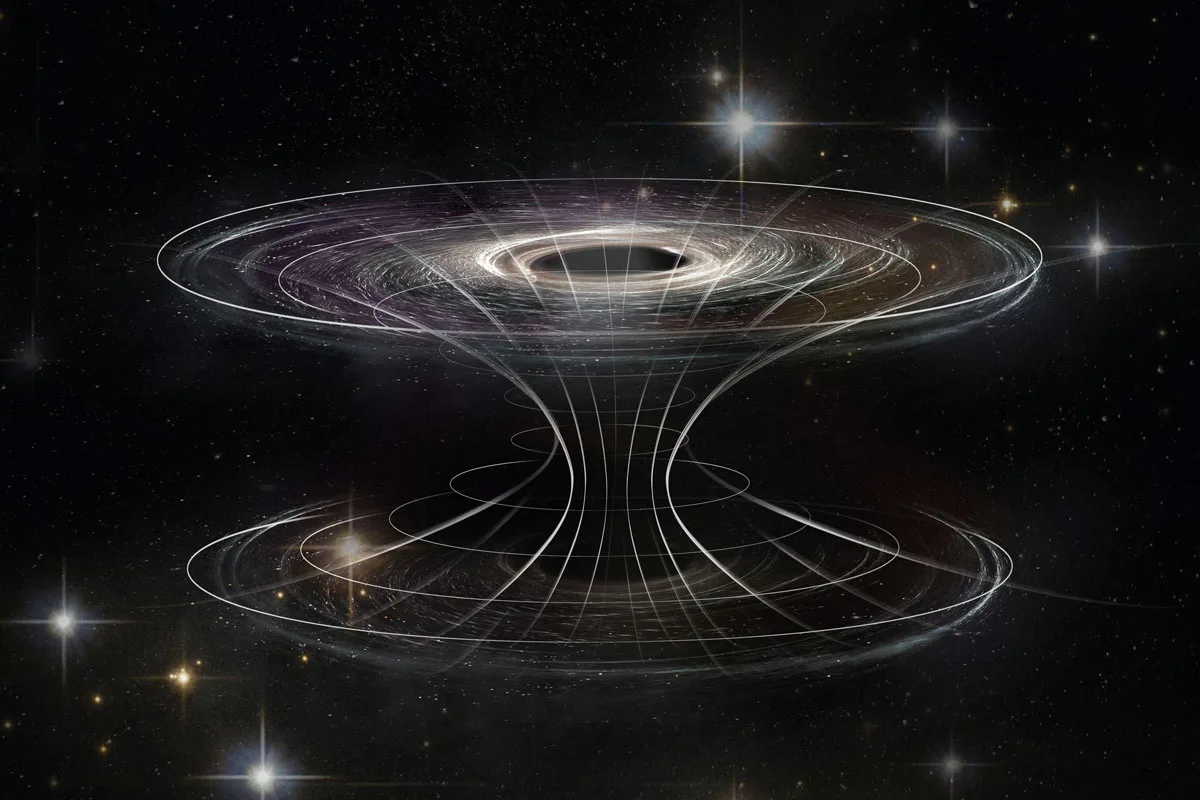
Black holes dramatically warp space-time, as described by Einstein’s General Relativity.
Curvature of Space-Time
Massive objects bend space-time like a heavy object on a stretched fabric. Black holes create:
- Extreme curvature
- Deep gravitational wells
Gravity Strength
Gravity near a black hole increases rapidly as distance decreases, eventually reaching a point where escape velocity exceeds light speed.
Orbital Effects
Objects near black holes:
- Orbit faster
- Experience extreme tidal forces
- Can be torn apart if too close
Event Horizon and the Point of No Return
The event horizon is one of the most important concepts in astrophysics.
What Happens at the Boundary
To an outside observer:
- Objects appear to slow down near the horizon
- Light becomes redshifted
- The object never seems to fully cross
To the falling object:
- Crossing happens normally
- No physical barrier is felt
This difference arises due to gravitational time dilation.
Time Dilation Near Black Holes
Black holes create extreme time distortion effects.
Gravitational Time Slowing
Time slows down near strong gravity fields:
- The closer you are, the slower time passes relative to distant observers
Near the event horizon:
- Time nearly stops from an external viewpoint
Practical Example
An astronaut near a black hole could experience:
- Minutes passing for them
- Years passing for distant observers
This makes black holes key objects in theoretical time physics.
Types of Black Holes
Black holes vary in size and formation history.
Stellar Black Holes
- Formed from collapsing stars
- Usually 3–100 solar masses
Supermassive Black Holes
- Found at galaxy centers
- Millions to billions of solar masses
- Example: Sagittarius A* at the center of the Milky Way
Intermediate Black Holes
- Rare and less understood
- Thought to form from merging smaller black holes
Primordial Black Holes (Hypothetical)
- Theoretical remnants from early universe
- Could be microscopic or small
Black Hole Detection Methods
Black holes cannot be seen directly, but their effects are observable.
Accretion Disk Radiation
Matter falling into black holes emits:
- X-rays
- Gamma rays
- High-energy radiation
These signals are detectable by space telescopes.
Gravitational Influence
Scientists detect black holes by observing:
- Star orbits
- Sudden gravitational anomalies
Gravitational Waves
When black holes collide, they produce ripples in space-time:
- Detected by observatories like LIGO
- Confirm Einstein’s predictions
Event Horizon Imaging
In 2019, the Event Horizon Telescope captured the first image of a black hole shadow.
Hawking Radiation and Quantum Effects
Black holes are not completely eternal.
Hawking Radiation Concept
Quantum physics suggests black holes emit tiny amounts of radiation due to:
- Particle-antiparticle fluctuations near the event horizon
Slow Evaporation
Over extremely long timescales:
- Black holes may slowly lose mass
- Eventually evaporate completely
Information Paradox
A major scientific question:
- What happens to information that falls into a black hole?
This remains unresolved in physics.
Black Holes and Galaxy Formation
Black holes are not just destructive—they are structural.
Galactic Centers
Most galaxies, including the Milky Way, contain supermassive black holes that:
- Influence star orbits
- Regulate galaxy structure
Star Formation Regulation
Black holes can:
- Trigger or suppress star formation
- Release energy that affects surrounding gas clouds
They act like cosmic regulators.
Tidal Forces and Spaghettification
One of the most extreme effects near black holes is tidal stretching.
Uneven Gravity Pull
Gravity is stronger closer to the black hole than farther away:
- This stretches objects vertically
- Compresses them horizontally
Spaghettification Process
Objects falling in may be stretched into thin shapes due to gravitational differences.
This effect becomes stronger near smaller black holes.
Black Hole Collisions and Cosmic Events
When black holes merge, they create some of the most powerful events in the universe.
Gravitational Wave Release
Collisions produce:
- Massive energy release
- Ripples in space-time
Energy Output
During merger events:
- Energy released can exceed that of entire galaxies briefly
Detection Importance
These events help scientists:
- Test relativity
- Understand cosmic evolution
- Map black hole populations
Role in Cosmic Evolution
Black holes influence the universe at large scales.
Matter Recycling
They help redistribute energy and matter through:
- Jets of radiation
- Accretion processes
Galactic Balance
They help maintain:
- Orbital stability
- Energy regulation in galaxies
Early Universe Formation
Black holes may have played a role in early galaxy development.
Scientific Mysteries and Unknowns
Black holes remain one of the biggest unsolved topics in physics.
Singularity Problem
Current physics breaks down at singularities.
Quantum Gravity
Scientists are still searching for a unified theory combining:
- Quantum mechanics
- General relativity
Information Paradox
Whether information is destroyed or preserved remains unknown.
Future Research and Exploration
Future missions aim to study black holes more deeply.
Advanced Telescopes
New telescopes will:
- Improve imaging resolution
- Detect deeper cosmic signals
Space-Based Observatories
Future satellites may observe:
- Black hole formation
- Early universe structures
Theoretical Physics Development
Research continues into:
- String theory
- Quantum gravity models
Conclusion
Black holes represent the most extreme environments in the universe, where gravity, time, and space behave in ways that challenge human understanding. They form from collapsed stars, influence entire galaxies, and create some of the most powerful events in cosmic history.
Far from being simple destructive objects, black holes are essential components of the universe’s structure. They regulate galaxy formation, generate gravitational waves, and may hold the key to understanding the deepest laws of physics.
As science advances, black holes remain at the frontier of human knowledge—cosmic mysteries that continue to reshape our understanding of reality itself.